

Insurance fraud represents a staggering financial drain on the industry. The Coalition Against Insurance Fraud estimates annual losses of $308.6 billion to insurance fraud in the United States alone. This translates to approximately $900 more per policyholder annually in increased premiums.
Traditional fraud detection methods relying on manual claim review cannot keep pace with increasingly sophisticated fraud schemes. Organizations implementing AI in insurance for innovation discover that machine learning transforms fraud detection from reactive investigation to proactive prevention.
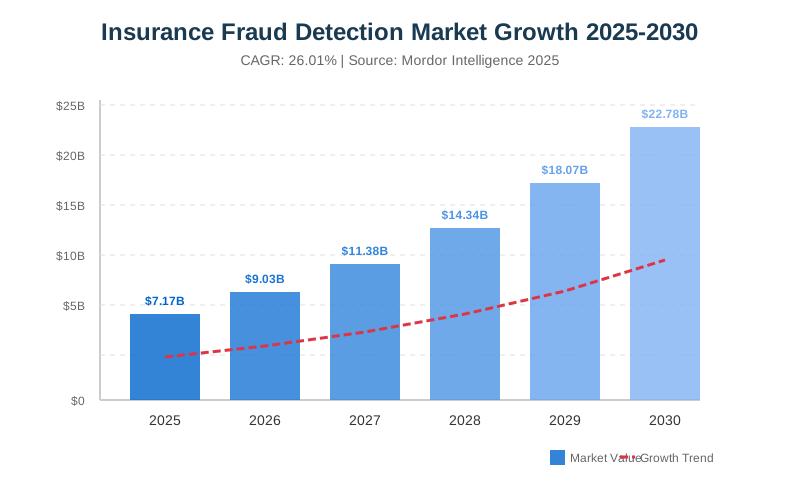
The insurance fraud analytics market reflects this urgency. Projected to grow from $7.17 billion in 2025 to $22.78 billion by 2030, the market demonstrates a compound annual growth rate of 26.01% as insurers invest heavily in AI-powered solutions.
The Scale and Impact of Insurance Fraud
Insurance fraud manifests across multiple categories, each creating distinct challenges for detection systems. Hard fraud involves deliberately fabricating losses to receive payouts. Examples include staged accidents, arson, or fake injuries. This premeditated crime typically results in felony charges and prison sentences.
Soft fraud occurs when policyholders exaggerate legitimate claims to receive larger payouts. Unlike hard fraud, it involves no premeditation but still costs insurers billions annually. Examples include overstating injury severity or falsely claiming expensive items in property losses.
The financial impact extends beyond direct losses. Fraud comprises approximately 10% of property-casualty insurance losses and loss adjustment expenses each year. For the typical American household, non-health insurance fraud costs between $400 and $700 annually in inflated premiums according to FBI estimates.
Property and casualty fraud alone contributes $90 billion annually. Auto insurance fraud adds $5.6 billion to $7.7 billion in excess payments yearly. Healthcare fraud likely steals tens of billions more, though exact figures remain debated due to detection challenges.
How AI Fraud Detection in Insurance Works
AI fraud detection in insurance leverages multiple machine learning techniques working in concert to identify suspicious patterns invisible to human reviewers. These systems analyze millions of data points across claims history, behavior patterns, and external data sources simultaneously.
Predictive fraud analytics builds models using historical fraud cases to identify characteristics common to fraudulent claims. Algorithms learn which combinations of factors most reliably indicate fraud. When new claims arrive, the system scores them based on fraud probability, automatically flagging high-risk cases for investigation.
Anomaly detection identifies claims that deviate significantly from normal patterns. Machine learning establishes baseline behaviors for legitimate claims across different insurance types, geographies, and circumstances. Claims exhibiting unusual characteristics trigger alerts even when they don’t match known fraud patterns.
Natural language processing analyzes unstructured text in claim descriptions, medical records, and correspondence. NLP detects inconsistencies in narratives, identifies language patterns associated with fraudulent claims, and flags contradictions between different documents in the same claim file.
Network analysis reveals fraud rings operating across multiple claims or policyholders. Graph algorithms identify suspicious relationships between claimants, healthcare providers, repair shops, and witnesses that suggest coordinated fraud schemes.
Case Study from Tricon Infotech: Real-Time Fraud Detection Platform
A major financial services company faced critical competitive disadvantages with manual fraud detection processes. Staff processed suspicious transactions one at a time, creating slow response times that allowed fraudulent claims to proceed before detection.
The Challenge:
- Manual review processes creating detection delays
- Inability to process high-volume transactions in real-time
- Growing sophistication of fraud schemes outpacing detection capabilities
- Need for near real-time reporting for decision-making
The Solution:
Tricon developed a comprehensive data pipeline and business intelligence platform. The multi-tier database architecture included a Bronze Database capturing all incoming data as master repository, a Silver Database with filtered data achieving significant size reduction, and a Gold Database with aggregated data optimized for high-performance reporting with frequent refreshes.
The platform implemented a complex rules-based analysis system with numerous safeguards for rule adherence and restricted rule update permissions. Extensive testing before production ensured client confidence in automated decisions. Near real-time reporting included portfolio overview, transaction lifecycle tracking, regulatory document management, and built-in competitive analysis tools.
Business Impact:
- Substantial portfolio growth over initial years
- Significant increase in business partners
- Processing time reduced from days to hours
- Team expanded significantly to support growth enabled by platform
Organizations exploring predictive analytics in insurance can learn from how real-time data processing enables proactive fraud prevention rather than reactive investigation.
Real-Time Fraud Detection Systems
Real-time fraud detection systems analyze claims as they’re submitted rather than days or weeks later. This immediate assessment provides several advantages over traditional post-submission review.
Automated business rules evaluate claims against predefined criteria instantly. Simple rule violations trigger immediate alerts. For example, claims exceeding policy limits, duplicate submissions, or submissions outside coverage periods receive automatic flags.
Machine learning models score claims in milliseconds. Systems trained on historical fraud data assign probability scores indicating likelihood each claim involves fraud. High-risk claims route automatically to specialized investigators while low-risk claims proceed through straight-through processing.
Multimodal analysis combines data from text, images, audio, and video. Computer vision assesses damage photos for inconsistencies. Voice analysis detects stress patterns in recorded claim calls. Document comparison identifies forged paperwork through subtle visual cues.
The immediate nature of real-time detection prevents fraudulent payouts before they occur rather than attempting recovery afterward. Organizations implementing AI-powered risk detection report significant reductions in both fraud losses and investigation costs.
Machine Learning Techniques for Fraud Detection
Multiple machine learning algorithms prove effective for insurance fraud detection, each offering distinct strengths for different fraud types and data characteristics.
Supervised learning models train on labeled datasets containing both fraudulent and legitimate claims. Common algorithms include logistic regression for baseline prediction, decision trees providing interpretable rules, random forests combining multiple decision trees for improved accuracy, and XGBoost achieving leading performance in many implementations.
Research shows XGBoost achieving 89% accuracy with 87% F1-scores in auto insurance fraud detection. The algorithm handles imbalanced datasets effectively, an important consideration since fraudulent claims typically represent small percentages of total submissions.
Unsupervised learning identifies unusual patterns without requiring pre-labeled fraud examples. Clustering algorithms group similar claims, with outlier claims flagged for investigation. Autoencoders learn normal claim patterns and detect anomalies deviating from learned representations.
Ensemble methods combine multiple algorithms to improve overall performance. Stacking different models leverages individual strengths while compensating for weaknesses. Organizations report classification accuracy improvements of 15-20% using ensemble approaches compared to single-model implementations.
Feature engineering remains critical for model performance. Recursive feature elimination identifies most predictive variables. Advanced implementations use domain expertise to create derived features capturing fraud indicators like claim velocity, claimant history patterns, and provider network relationships.
AI-Powered Risk Detection Beyond Claims
AI fraud detection extends beyond individual claim analysis to encompass the entire policy lifecycle and ecosystem interactions. Premium leakage represents a massive hidden cost, with insurers losing at least $29 billion yearly from missing or incorrect policyholder information.
Application fraud occurs when policyholders intentionally misrepresent information to lower premiums. Machine learning detects inconsistencies between stated information and external data sources. AI systems cross-reference addresses, vehicle information, and driver histories against public records and commercial databases.
Garaging misrepresentation involves stating incorrect vehicle locations to obtain lower rates. Telematics data provides actual usage patterns conflicting with stated garaging locations. Geospatial analysis identifies vehicles consistently operating far from claimed addresses.
Agent fraud detection monitors for patterns suggesting dishonest intermediary behavior. Red flags include unusual policy volumes from specific agents, premium diversion patterns, and suspicious policy modifications. Network analysis reveals agent networks engaging in coordinated misconduct.
Organizations implementing comprehensive AI fraud detection across all touchpoints report fraud reduction rates of 30-40% while simultaneously improving legitimate claim processing speeds.
Implementation Challenges and Best Practices
Successful AI fraud detection implementation requires addressing several technical and organizational challenges. Data quality stands as the primary obstacle. Models trained on incomplete or inaccurate data produce unreliable results.
Class imbalance presents significant difficulties since fraudulent claims represent small percentages of total submissions. Synthetic Minority Over-sampling Technique (SMOTE) addresses imbalance by generating synthetic fraud examples during model training. This technique improved detection accuracy by 15-25% in research studies.
Model interpretability becomes crucial for regulatory compliance and investigator acceptance. Black-box models may achieve high accuracy but provide no explanation for fraud flags. SHAP (Shapley Additive Explanations) analysis reveals which features drive each fraud score, enabling investigators to understand and validate model decisions.
False positive rates require careful management. Flagging too many legitimate claims wastes investigator time and delays customer payouts. Organizations report optimal results maintaining false positive rates under 5% while detecting 70-80% of actual fraud.
Continuous model updating proves essential as fraud patterns evolve. Fraudsters adapt tactics when detection systems identify their schemes. Regular retraining on recent fraud examples maintains model effectiveness over time.
The Future of Insurance Fraud Detection
Emerging technologies promise further fraud detection capabilities. Generative AI creates synthetic fraud scenarios for model training without requiring actual fraud data. This technique addresses data scarcity challenges while maintaining privacy.
Federated learning enables multiple insurers to collaboratively train fraud detection models without sharing sensitive claim data. Each insurer’s data remains private while contributing to collective fraud pattern identification.
Blockchain technology provides immutable claim records preventing tampering and enabling cross-insurer fraud verification. Decentralized identity verification reduces identity fraud while protecting privacy.
The insurance fraud detection market will reach $22.78 billion by 2030 as adoption accelerates. Organizations investing now in AI-powered fraud detection gain competitive advantages through lower loss ratios and improved customer experience via faster legitimate claim processing.
FAQs
What is insurance fraud?
Insurance fraud occurs when someone intentionally deceives an insurance company to obtain benefits they’re not entitled to. This includes faking accidents, inflating claims, or providing false information on applications. Hard fraud involves deliberate schemes like staged accidents, while soft fraud involves exaggerating legitimate claims to receive larger payouts.
How much does insurance fraud cost?
Insurance fraud costs $308.6 billion annually in the United States. This adds approximately $900 per year to every policyholder’s premiums. A family of four pays about $3,600 more annually due to fraudulent claims driving up insurance costs for everyone.
How does AI detect insurance fraud?
AI uses machine learning algorithms to analyze millions of data points and identify suspicious patterns. Systems score claims in real-time, flag anomalies, analyze text for inconsistencies, and detect fraud rings through network analysis. XGBoost algorithms achieve 89% accuracy in detecting fraudulent auto insurance claims, significantly outperforming manual review methods.
